Madriu-Perafita-Claror Valley – The Heart of Andorra
The Madriu-Perafita-Claror Valley is a glacial valley in the south-east of Andorra. Andorra is located in the eastern Pyrenees Mountains, bordered by France to the north and Spain to the south. The landscape of cliffs and glaciers with open pastures and steep wooded valleys covers an area of 4,247 ha, nearly 10% of the principality of Andorra. The Madriu-Perafita-Claror Valley is an isolated valley. The valley is not virgin land; the site features summer settlements, terraced fields, shepherds' huts, barns, dry stone walls and stone paths. The countless charcoal-making sites in the woods bear witness to ironworking. People have lived and worked uninterruptedly in the Madriu-Perafita-Claror Valley for seven centuries; the valley is the last remaining part of the Andorran rural way of life.
The Madriu-Perafita-Claror Valley is only accessible on foot along ancient stone paths and donkey tracks. There are no plans to build an access road into the valley. One of the accesses to the isolated Madriu-Perafita-Claror Valley is on the road to the village of Engolasters, located two km east of the capital city Andorra la Vella. Many tracks link the valley to Catalonia in the south, Roussillon to the east and the Languedoc to the north. The Madriu-Perafita-Claror Valley was declared a UNESCO World Heritage Site in 2004.
www.werelderfgoedfotos.nl © Copyright World Heritage Photos
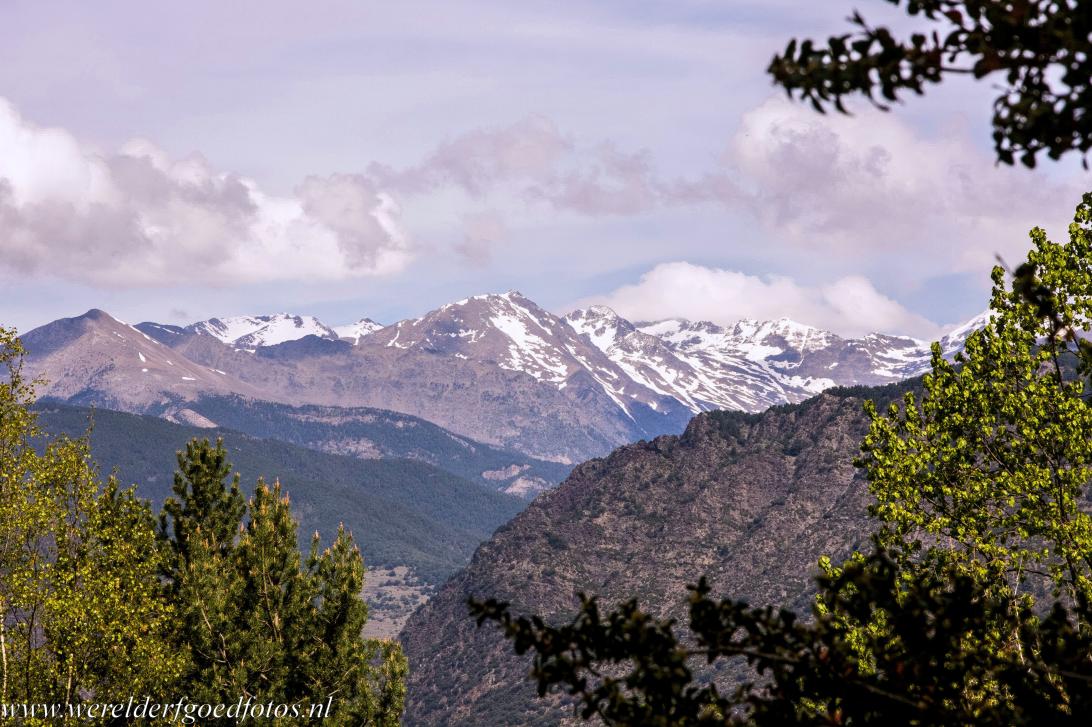
The immense snow-covered peaks of the Pyrenees, viewed from the Madriu-Perafita-Claror Valley. This imposing valley is situated in the south-east of Andorra, high in the Pyrenees. This isolated valley is only accessible on foot or by donkey. There is a vast network of footpaths and donkey trails in the valley. The Madriu-Perafita-Claror Valley gained status as a UNESCO World Heritage Site in 2004. The site was extended in 2006 to include a huge buffer zone, reaching the Spanish border.

The immense snow-covered peaks of the Pyrenees, viewed from the Madriu-Perafita-Claror Valley. This imposing valley is situated in the south-east of Andorra, high in the Pyrenees. This isolated valley is only accessible on foot or by donkey. There is a vast network of footpaths and donkey trails in the valley. The Madriu-Perafita-Claror Valley gained status as a UNESCO World Heritage Site in 2004. The site was extended in 2006 to include a huge buffer zone, reaching the Spanish border.

The Madriu-Perafita-Claror Valley in Andorra is a rugged and imposing landscape of cliffs and glaciers featuring open pastures and steep wooded valleys. The highest peak in this valley is the 2,905 metre-high Pic de la Portelleta. There are only two small settlements in this isolated valley, Ramio and Entremesaigües, surrounded by terraced fields; both are now only in use during the summer months. The valley is a true paradise for wildlife lovers.

The Vall del Madriu (Madriu Valley) is part of the UNESCO World Heritage Site: Madriu-Perafita-Claror Valley. The landscape of rugged rocks, steep wooded valleys, glaciers, streams, lakes and open pastures covers an area of approximately 4,247 hectares, nearly 10% of the Principality of Andorra. People have lived and worked uninterruptedly in the Madriu-Perafita-Claror Valley for more than seven centuries. This isolated valley is also a haven for wildlife.

Several footpaths and donkey trails connect the Madriu-Perafita-Claror Valley to the centre of Andorra. The Coronallacs Trail is a circular trail; the first leg of the 90-km-long trail leads through the Madriu-Perafita-Claror Valley and runs along the Madriu River. The Perafita refuge is one of the four manned mountain huts along the Coronallacs Trail. Andorra is a microstate in the Pyrenees, bordered by France to the north and Spain to the south.

The crystal clear water of the River, one of the many mountain streams flowing through the Madriu-Perafita-Claror Valley. Until the end of the 18th century, iron smelting took place on the banks of the river using local iron ore. This quiet valley is located in the south-east of Andorra. The area encompasses the valleys of the Madriu, Perafita, and Claror rivers: pristine mountain streams that originate in the high glacial landscape of Andorra.

One of the small, historic donkey paths running alongside a dry-stone wall, known as pedra seca, a characteristic feature of the Madriu-Perafita-Claror Valley. Enormous, moss-covered boulders lie beside the path. In this valley, wild primroses, sweet violets, lungwort, Hepatica (liverleafs) and hazel trees bloom in early spring. This valley is also a true birdwatcher's paradise; eighty-nine bird species nest here. The grandalla (Narcissus poeticus) is a white narcissus with a yellow center; it is the national flower of Andorra and is abundant in this valley.

The Madriu-Perafita-Claror Valley is considered to be the 'spiritual heart' of Andorra. Numerous waterfalls tumble down the rocks on their way to the River Madriu as it winds through the Vall del Madriu (Madriu Valley). The Madriu, the Perafita and the Claror are the rivers that give this valley its name. The Madriu Valley forms an important part of this UNESCO World Heritage Site. Numerous hiking trails connect the area with Spain to the south and France to the north.

A dry-stone shepherd's hut in an old orchard in the Madriu Valley, a part of the vast Madriu-Perafita-Claror Valley. During the summer months, shepherds lived in this type of dry-stone hut, known as orris. The valley is not virgin land; it features summer settlements, terraced fields, barns, dry-stone walls, stone paths and sites where charcoal was produced for the iron industry. Historically, dry-stone walls enclosed the pastures, which were grazed by sheep, cattle and horses.

One of the many donkey paths in the Madriu-Perafita-Claror Valley, with the Pyrenees Mountains in the background. Hardly anything has changed in this secluded valley since the Middle Ages, partly because no roads run through the area. The valley is only accessible on foot along the stone tracks and donkey trails; there are no plans to build an access road. The area is a haven for nature lovers. Thirty mammal species occur here, including the Pyrenean chamois (isard), a symbol of the Pyrenees, and 114 different species of butterflies.

The Madriu is a mountain stream with crystal-clear water that meanders through the Madriu-Perafita-Claror Valley. Deze valley coincides with the second largest watershed basin in Andorra. A primary access to the valley is on the road to the tiny village of Engolasters, located about two kilometers east of Andorra la Vella, the capital city of Andorra. Numerous tracks link the valley to Catalonia in Spain to the south, Roussillon in France to the east and the Languedoc in France to the north.
